About

My research develops mathematical theory and practical software for reconstructing and analysing phylogenetic trees and networks. After studying applied mathematics at the University of Twente, I obtained my PhD at Eindhoven University of Technology. After that, I worked as a postdoc at the University of Canterbury, as a teacher in primary and secondary schools in Tanzania and Kenya, and as a researcher at CWI in Amsterdam. I joined TU Delft in 2014.
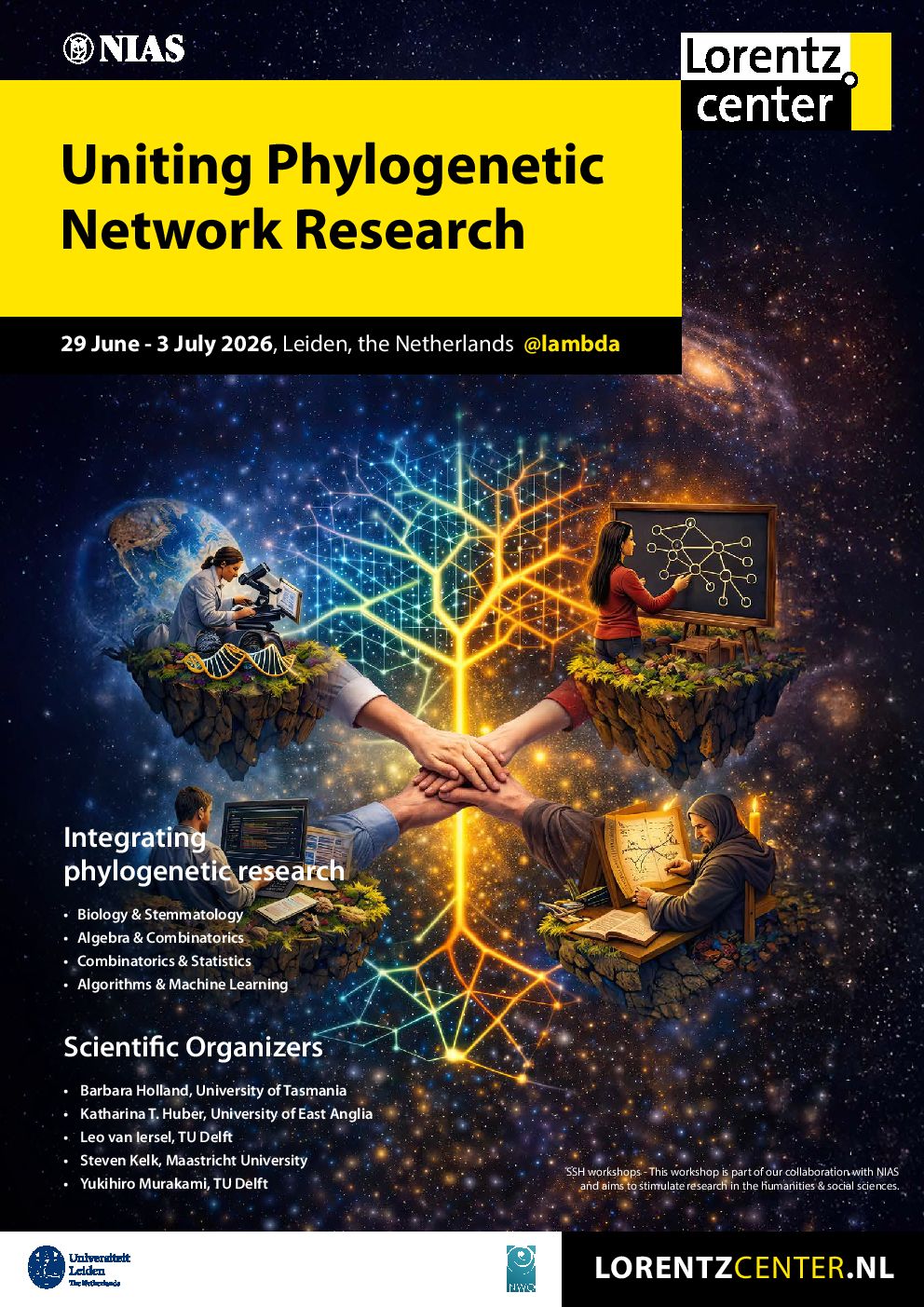
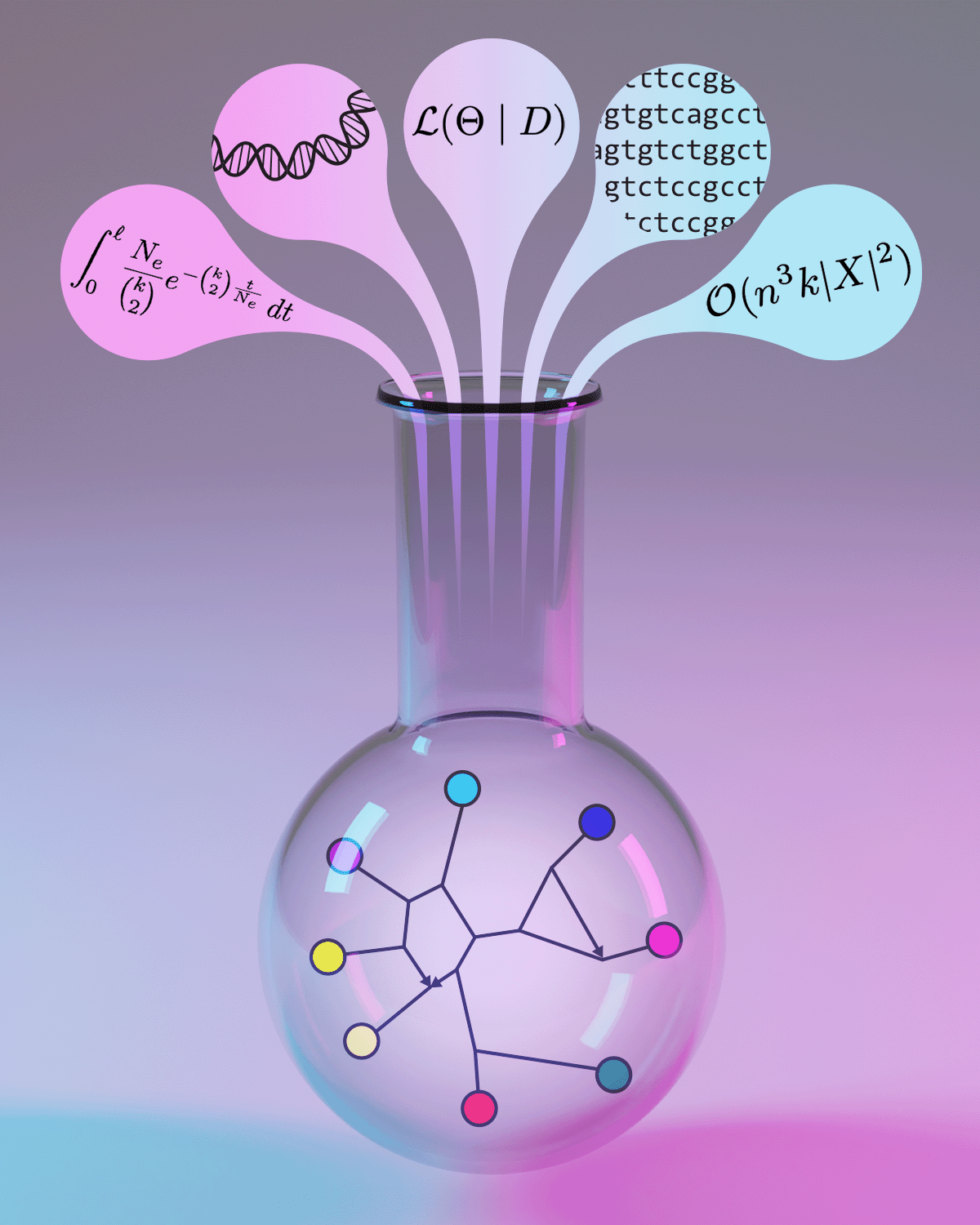
I’m co-chair of AIM, TU Delft representative of DIAMANT, recommender for Peer Community In Mathematical & Computational Biology and guest editor of a topical collection in Annals of Combinatorics. Also see our blog The Genealogical World of Phylogenetic Networks.

Research Projects

Identifiability of evolutionary histories

With Steven Kelk, Mark Jones, Martin Frohn and Niels Holtgrefe.

NWO ENW-M2 grant


journal article
Bounds on the sequence length sufficient to reconstruct binary level-1 phylogenetic networks under the CFN model
Martin Frohn, Niels Holtgrefe, Leo van Iersel, Mark Jones, Steven Kelk
Annals of Combinatorics, 2026. journal arXiv
Determines how much genetic sequence data is actually needed to reconstruct a common type of evolutionary network with high confidence, showing that the required amount of data scales predictably with the number of species involved.
Phylogenetic trees and networks are graphs used to model evolutionary relationships, with trees representing strictly branching histories and networks allowing for events in which lineages merge, called reticulation events. While the question of data sufficiency has been studied extensively in the context of trees, it remains largely unexplored for networks. In this work we take a first step in this direction by establishing bounds on the amount of genomic data required to reconstruct binary level-$1$ semi-directed phylogenetic networks, which are binary networks in which reticulation events are indicated by directed edges, all other edges are undirected, and cycles are vertex-disjoint. For this class, methods have been developed recently that are statistically consistent. Roughly speaking, such methods are guaranteed to reconstruct the correct network assuming infinitely long genomic sequences. Here we consider the question whether networks from this class can be uniquely and correctly reconstructed from finite sequences. Specifically, we present an inference algorithm that takes as input genetic sequence data, and demonstrate that the sequence length sufficient to reconstruct the correct network with high probability, under the CFN model of evolution, scales logarithmically, polynomially, or polylogarithmically with the number of taxa, depending on the parameter regime. As part of our contribution, we also present novel inference rules for quartet data in the semi-directed phylogenetic network setting.
@article{frohn2026bounds,
  author = {Frohn, Martin and Holtgrefe, Niels and van Iersel, Leo and Jones, Mark and Kelk, Steven},
  title = {Bounds on the sequence length sufficient to reconstruct binary level-1 phylogenetic networks under the {CFN} model},
  journal = {Annals of Combinatorics},
  doi = {10.1007/s00026-026-00830-0},
  year = {2026}
}
Optimization for and with Machine Learning

With Karen Aardal, Dick den Hertog, Etienne de Klerk, Monique Laurent, Guido Schäfer, Leen Stougie, Esther Julien, Giulia Bernardini and others.

NWO ENW-GROOT grant website


journal article
Inferring Phylogenetic Networks from Multifurcating Trees via Cherry Picking and Machine Learning
Giulia Bernardini, Leo van Iersel, Esther Julien, Leen Stougie
Molecular Phylogenetics and Evolution, 199:108137, 2024. journal
Presents FHyNCH, software that combines a tree-simplification technique with machine learning to reconstruct evolutionary networks from large collections of trees, even when those trees are only partially resolved and cover different, overlapping sets of species — a scale and flexibility beyond what earlier methods could handle.
The Hybridization problem asks to reconcile a set of conflicting phylogenetic trees into a single phylogenetic network with the smallest possible number of reticulation nodes. This problem is computationally hard and previous solutions are restricted to small and/or severely restricted data sets, for example, a set of binary trees with the same taxon set or only two non-binary trees with non-equal taxon sets. Building on our previous work on binary trees, we present FHyNCH, the first algorithmic framework to heuristically solve the Hybridization problem for large sets of multifurcating trees whose sets of taxa may differ. Our heuristics combine the cherry-picking technique, recently proposed to solve the same problem for binary trees, with two carefully designed machine-learning models. We demonstrate that our methods are practical and produce qualitatively good solutions through experiments on both synthetic and real data sets.
@article{bernardini2024inferring,
  author = {Bernardini, Giulia and van Iersel, Leo and Julien, Esther and Stougie, Leen},
  title = {{Inferring Phylogenetic Networks from Multifurcating Trees via Cherry Picking and Machine Learning}},
  journal = {Molecular Phylogenetics and Evolution},
  year = {2024},
  volume = {199},
  pages = {108137},
  doi = {10.1016/j.ympev.2024.108137},
  url = {https://doi.org/10.1016/j.ympev.2024.108137}
}

Treewidth Parameterizations of Network Construction Problems in Phylogenetics

With Mark Jones.

NWO ENW-KLEIN grant


journal article
Embedding phylogenetic trees in networks of low treewidth
Mark Jones, Mathias Weller, Leo van Iersel
Discrete Mathematics & Theoretical Computer Science, 25(2):2, 2023. Preliminary version in ESA 2022, LIPIcs 244:69. journal arXiv conference
Gives the first efficient algorithm for checking whether a proposed evolutionary tree is consistent with a network, based on a general measure of how tree-like the network's underlying structure is, extending fast verification to a broader range of networks than earlier specialized methods could handle.
Given a rooted, binary phylogenetic network and a rooted, binary phylogenetic tree, can the tree be embedded into the network? This problem, called \textsc{Tree Containment}, arises when validating networks constructed by phylogenetic inference methods.We present the first algorithm for (rooted) \textsc{Tree Containment} using the treewidth $t$ of the input network $N$ as parameter, showing that the problem can be solved in $2^{O(t^2)}\cdot|N|$ time and space.
@article{jones2023embedding,
  author = {Jones, Mark and Weller, Mathias and van Iersel, Leo},
  title = {{Embedding phylogenetic trees in networks of low treewidth}},
  journal = {Discrete Mathematics & Theoretical Computer Science},
  year = {2023},
  volume = {25},
  number = {2},
  pages = {2},
  archivePrefix = {arXiv},
  eprint = {2207.00574},
  url = {https://arxiv.org/abs/2207.00574}
}

Encoding, reconstructing and comparing complex evolutionary scenarios

With Mark Jones, Yukihiro Murakami and Remie Janssen.

NWO Vidi grant


journal article
Orchard Networks are Trees with Additional Horizontal Arcs
Leo van Iersel, Remie Janssen, Mark Jones, Yukihiro Murakami
Bulletin of Mathematical Biology, 84:76, 2022. journal arXiv
Shows that a class of evolutionary networks introduced purely for its computational advantages actually corresponds to a natural and biologically meaningful picture — an ordinary tree with extra sideways connections representing horizontal gene transfer — and proves that one can always move between any two such networks via a bounded number of small rearrangement steps.
Phylogenetic networks are used in biology to represent evolutionary histories. The class of orchard phylogenetic networks was recently introduced for their computational benefits, without any biological justification. Here, we show that orchard networks can be interpreted as trees with additional \emph{horizontal} arcs. Therefore, they are closely related to tree-based networks, where the difference is that in tree-based networks the additional arcs do not need to be horizontal. Then, we use this new characterization to show that the space of orchard networks is connected under the rNNI rearrangement move, with a diameter of at most $4kn+n\lceil \log_2(n) \rceil +2k+6n-8$.
@article{iersel2022orchard,
  author = {van Iersel, Leo and Janssen, Remie and Jones, Mark and Murakami, Yukihiro},
  title = {{Orchard Networks are Trees with Additional Horizontal Arcs}},
  journal = {Bulletin of Mathematical Biology},
  year = {2022},
  volume = {84},
  pages = {76}
}

Bringing phylogenetic networks to life

NWO Veni grant


journal article
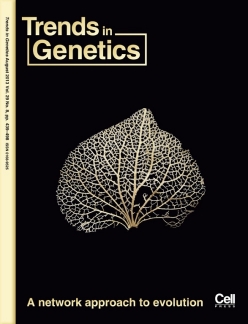
Networks: expanding evolutionary thinking
Eric Bapteste, Leo van Iersel, Axel Janke, Scot Kelchner, Steven Kelk, James O. McInerney, David A. Morrison, Luay Nakhleh, Mike Steel, Leen Stougie, James Whitfield
Trends in Genetics, 29(8):439--441, 2013. journal
Argues that evolutionary relationships are often better represented by networks than by trees alone. The article highlights how network models capture reticulation and complex genomic histories.
Networks allow the investigation of evolutionary relationships that do not fit a tree model. They are becoming a leading tool for describing the evolutionary relationships between organisms, given the comparative complexities among genomes.
@article{bapteste2013networks,
  author = {Bapteste, Eric and van Iersel, Leo and Janke, Axel and Kelchner, Scot and Kelk, Steven and McInerney, James O and Morrison, David A and Nakhleh, Luay and Steel, Mike and Stougie, Leen and Whitfield, James},
  title = {{Networks: expanding evolutionary thinking}},
  journal = {Trends in Genetics},
  year = {2013},
  volume = {29},
  number = {8},
  pages = {439--441}
}